Single pour
New or replacement slab
The elements are fixed to the reinforcing and covered in the same pour as the slab.
- Planned with the concrete contractor
- Elements sit near the top of the slab
- The simplest case for even heating
Snow melting: Concrete
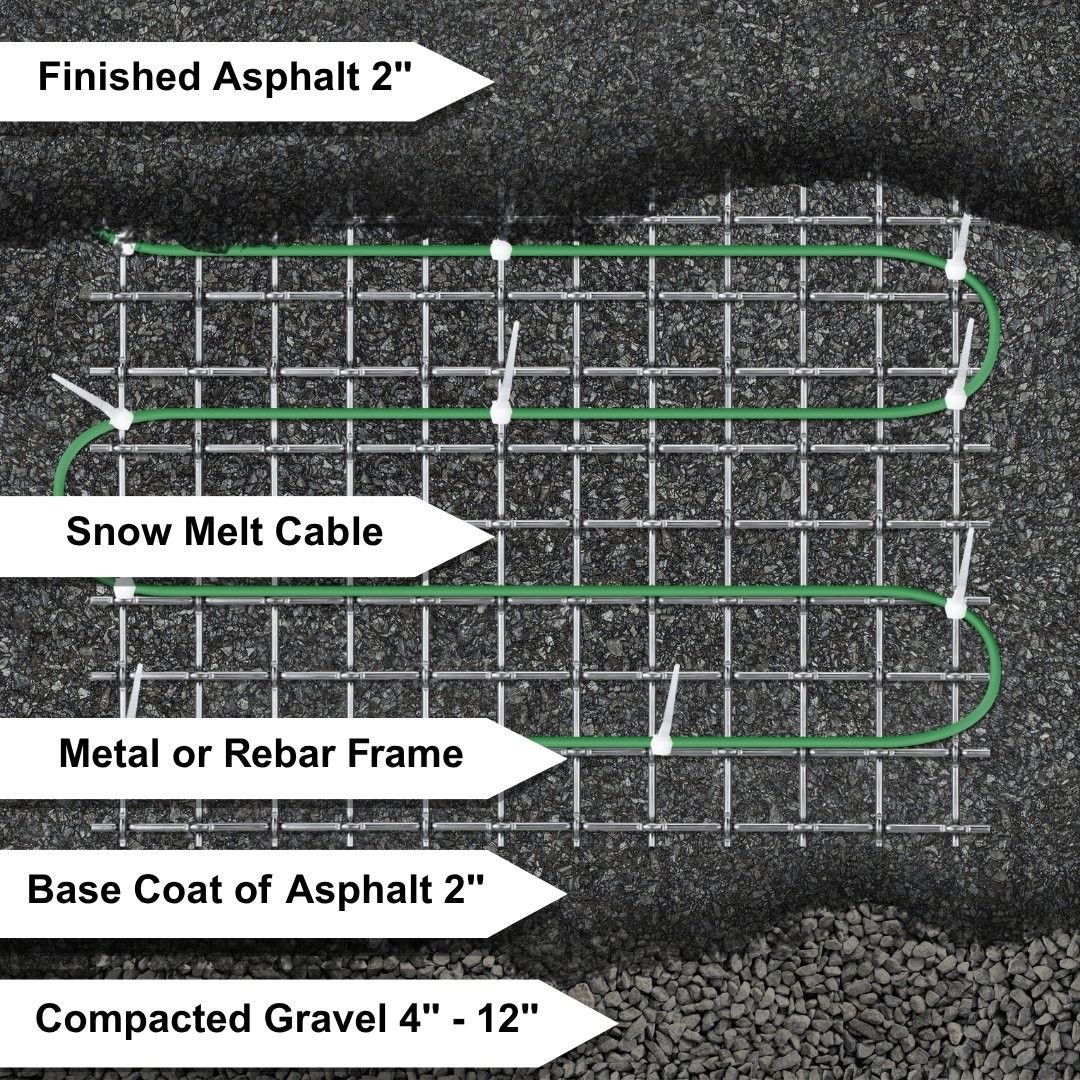
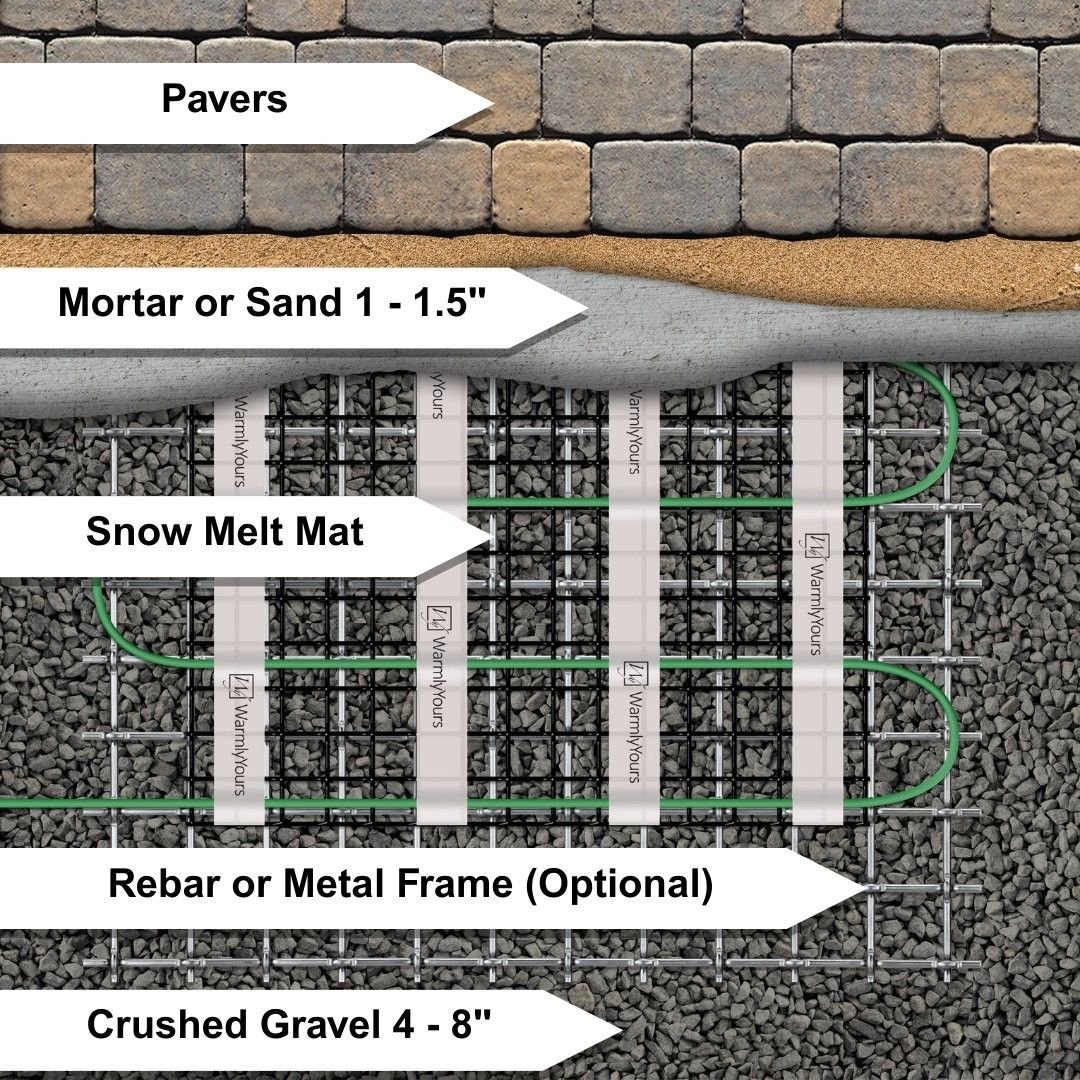
In concrete, the heating is tied in near the top of the slab before the pour, then covered by the finished concrete. It is planned alongside the concrete work, not added afterwards.
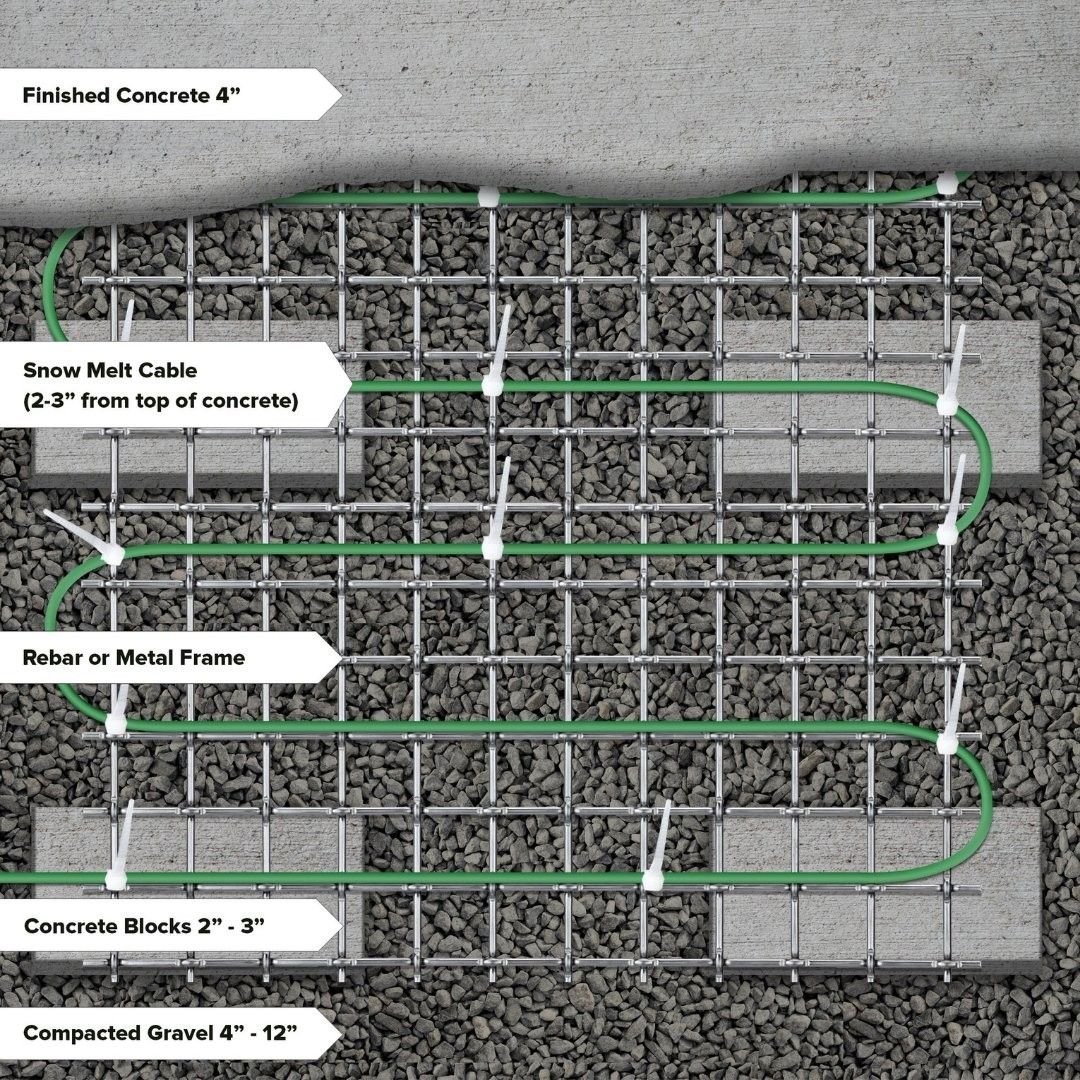
The elements go in near the top of the slab, held on a frame so the spacing stays even while the concrete is poured.
The order of work matters: the elements are protected and tested as the surface goes on.
The concrete contractor prepares a compacted crushed-stone base and places the mesh or rebar.
The electrician attaches cable or mats to the frame at the design spacing and props the frame to the specified height.
Cold leads run in conduit to a junction box, and a slab sensor can be placed in an open area at this stage.
Concrete is poured with care around the elements, without heavy equipment over exposed cable.
The electrician tests the elements during the pour and again once the slab has cured.
The route depends on whether the concrete is about to be poured or is already there.
Single pour
The elements are fixed to the reinforcing and covered in the same pour as the slab.
Retrofit
The manufacturer describes two routes for concrete that is already in place.
Both are installed in concrete. Open rectangles suit mats; shapes, curves and stairs suit cable.
Open areas
Heating cable pre-spaced on a mesh, laid on the frame across open slabs.
Shapes and stairs
Loose cable tied to rebar or mesh, laid to the shape of the slab.
Direct answers. Your design confirms the details for your property.
Yes. In new concrete, heating cable or mats are fixed to reinforcing mesh or rebar near the top of the slab before the concrete is poured, so they end up inside the finished slab.
The manufacturer’s method places the elements near the top of the slab, not deep, so the heat reaches the surface. Your design and the concrete contractor confirm the exact depth for your slab.
Often. The manual describes two routes: pouring a new layer of concrete over heating cable laid on the existing slab, or cutting grooves into the finished concrete for cable. An assessment of your slab confirms which is possible.
They are planned in the design. Heating elements are not run across expansion joints, and posts and railings are pre-sleeved so the concrete does not have to be drilled through the heating layer.
The concrete contractor prepares the base and pours the slab, and a qualified electrician fixes, connects and tests the heating elements. MeltGrid coordinates the design and both trades.
The installation method changes with the surface.
Can this go under an existing driveway? See retrofit considerations
Tell us about the surface and the area. We come back with a design and an estimate.